Procedure for

Sensitivity Assessment

Know the Lower Limit of Fluorescence with BioSure Negative Control


Home | Menu | Comments | Ordering


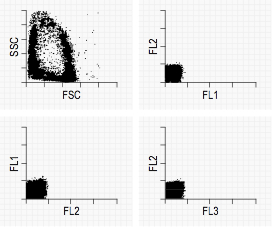
This procedure is used to assess a flow cytometer's lower limit of fluorescence by using the Negative Control, which consists of chicken erythrocytes that have been fixed in osmium tetroxide (OsO4). The fixation process quenches cellular fluorescence and results in a particle that has very low autofluorescence. Daily use of this negative standard in immunophenotyping assays demonstrates that the flow cytometer is capable of detecting particles with lower fluorescence than unstained target cells. Discrimination of dimly fluorescing target cells (cellular autofluorescence or isotypic control cells) from the negative control cells proves that the instrument is sensitive enough to perform the immunophenotyping assay. This becomes especially critical when measuring markers of low antigen density on the cell surface such as with activation, natural killer cell or some B cell antibodies.


Fluorescence Sensitivity Procedure

 1) Align the instrumentation optics, if necessary.
 2) Prepare a cell suspension of leukocytes from a venous blood sample collected from a control donor. Lyse the erythrocytes using the same lysing method which will be used on the laboratory samples. Fix the lysed whole blood sample in a 2% buffered paraformaldehyde solution.
 3) Place the fixed sample on the cytometer. Set the instrument parameters as follows: FSC-linear, SSC-linear, FL1-log, FL2-log. Adjust the FSC amplifier gain to position the left edge of the lymphocyte population below mid-scale on the forward scatter display. Adjust the SSC to position the top of the granulocyte population close to the edge of the side scatter display. Record the FSC and SSC amplifier and gain settings.
 4) Set a gate around the lymphocytes and activate the gate. Change the display parameters to FL1 and FL2.
 5) Adjust the high voltage on the Fluorescence 1 PMT to position the unstained lymphocytes in the first decade of the FL1 display. Adjust the high voltage on the Fluorescence 2 PMT to position the unstained lymphocytes in the first decade of the FL2 display. Repeat the PMT adjustment for any other parameters (FL3 for example), if desired. Record the PMT voltage settings and the median channel numbers for the populations in each of the fluorescence parameters.
 6) Repeat Steps 1 - 5 at least nine times using venous blood collected from different control donors. Average the PMT settings for each of the parameters - SSC, FL1 and FL2. Record the average setting and median channel number for each of the parameters. Since the FSC detector is a photo diode, only the amplifier setting will be recorded.
 7) Prepare a fresh dilution of the Negative Control to achieve a flow rate of about 500 - 1000 events per second. Place the tube on the cytometer.  
 8) Adjust the FSC amplifier gain until both peaks of the negative control population can be seen in the forward scatter histogram display. Once the gain has been established, this setting will be used as the FSC reference target value and should not be altered in subsequent daily monitorings. Record the FSC gain setting.
 9) Proceed to an FL1 vs FL2 dot plot or bit mapped display. Keep the same fluorescence PMT settings in steps 5 and 6. Determine and record the median channel number for each of the fluorescence parameters.

Evaluation

The median fluorescence channel number of the Negative Control should be lower than the median fluorescence channel number for the unstained lymphocytes. Autofluorescence of unstained lymphocytes has a fluorescence equivalent intensity of approximately 1000 molecules of fluorescein (excitation at 488 nm). Since the cells in the Negative Control have little or no autofluorescence, a difference in fluorescence between the two populations will demonstrate that the flow cytometer is sensitive enough to distinguish between unstained cells and dimly fluorescing cells.

If the median fluorescence channel number of the Negative Control is equal to or greater than the median fluorescence channel number of the unstained lymphocytes, then instrument sensitivity in the fluorescence parameters may be suspect. Cleaning, realignment or servicing of the instrument may be necessary to restore sensitivity in the fluorescence parameters.


Click here for the BioSure® Negative Control data sheet

Click here to find out more about the BioSure® Negative Control and other controls


BioSure®
1050 Whispering Pines Lane, Suite F
Grass Valley, CA 95945


Phone (800) 345-2267 or
(530) 273-5095
Fax (530) 273-5097